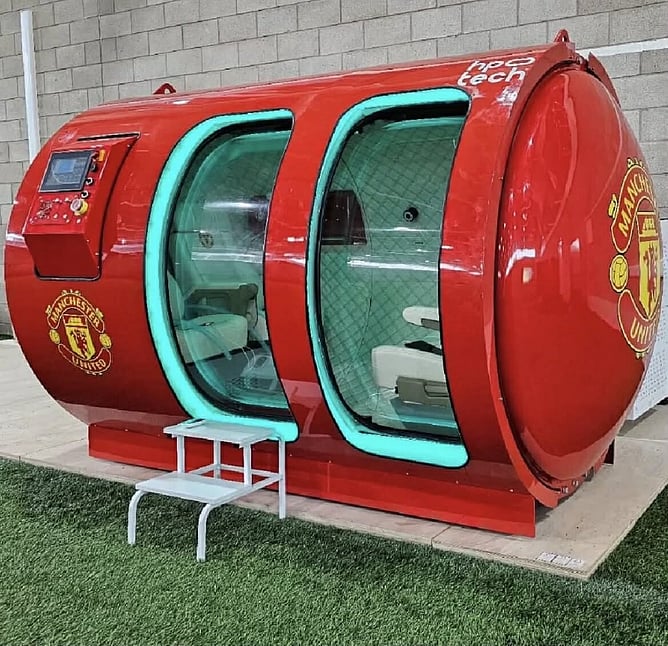
Why Sports Franchises Are Turning to Hyperbaric Oxygen Therapy (HBOT)
In elite sport, marginal gains matter. Recovery speed, injury resilience, and performance optimisation are now central to success - which is why more professional sports franchises are integrating Hyperbaric Oxygen Therapy (HBOT) into their high-performance programmes.
But this isn't just a trend - there is a growing body of research helping explain why.
Recovery is one of the biggest challenges in modern sport.
A randomised controlled trial in athletes found that HBOT significantly reduced markers of muscle damage (such as creatine kinase and myoglobin) and improved pain scores compared to the control group (Early recovery of exercise-related muscular injury by HBOT; Chen-Yu Chen et al; Biomed Res Int. 2019).
These findings suggest:
Reduced muscle damage
Faster physiological recovery
Improved readiness between matches
HBOT's role in injury healing and return-to-play is one of it's strongest use cases. Research shows HBOT can:
Stimulate collagen production and fibroblast activity
Promote angiogenesis (new blood vessel formation)
Reduce inflammation
These mechanisms are directly linked to improved healing of muscles, tendons, and ligaments, and may shorten return-to-play timelines.
(Effect of hyperbaric oxygen on the ligament healing process in rats; Mashitori et at; Clin Orthop. 2004) (Effects of different exposures of hyperbaric oxygen on ligament healing in rats; Ishii et al; J Orthop Res Off Publ Orthos Res Soc. 2002) (The effect of intermittent hyperbaric oxygen on short term recovery from grade 2 medial collateral ligament injuries; Soolsma; 1996) (Effects of hyperbaric oxygen treatment on tendon graft and tendon-bone integration in bone tunnel: biochemical and histological analysis in rabbits; Yeh et at; J Orthop Res Off Publ Orthop Res Soc, 2007)
Beyond recovery, some teams are exploring HBOT for performance gains. A double-blind, placebo-controlled study in trained athletes found that repeated HBOT sessions let to:
Significant increases in VO2 max
Improved anaerobic threshold
Enhanced mitochondrial function
These adaptations are key markers of endurance and energy efficiency (Effects of Hyperbaric Oxygen Therapy on Mitochondrial Respiration and Physical Performance in Middle-Aged Athletes: A Blinded, Randomised Control Trial; Hadanny et al, 2022)
This positions HBOT not just as a recovery tool - but as a potential performance enhancer when used strategically.
When applied to manage fatigue and match load, not all studies show immediate performance improvements - but they still highlight useful effects.
For example, a 2024 randomised trial in football players found that a single HBOT session did not significantly change physical performance metrics, but did improve perceived fatigue and recovery scores shortly after treatment. (Effects of hyperbaric oxygen therapy on recovery after a football match in young players: a double-blind randomised controlled trial; Gusic et al; Frontiers in physiology, 2024)
This suggests:
HBOT may be more effective as a cumulative or repeated intervention
It may improve subjective recovery, which still influences performance
This aligns with how many sports franchises actually use HBOT - consistently, not as a one-off.
HBOT has well documented physiological effects on reduced inflammation and tissue stress. It stimulates vasoconstriction (reducing swelling), increases oxygen diffusion to tissues, and enhances the cellular repair processes. These mechanisms help control inflammation and support recovery after high-intensity exercise or injury.
For contact sports or high-load athletes, managing inflammation is critical for long-term durability
Why are franchises investing?
From a performance department perspective, HBOT ticks several boxes:
Non-invasive and drug-free
Supports multiple systems (muscle, bone, and brain)
Aligns with evidence-based recovery strategies
Even where evidence is still evolving, the risk-to-benefit ratio is attractive, which is why many teams adopt it as part of a broader recovery ecosystem.
It's important to be balanced. Strong evidence supports HBOT for injury recovery and physiological adaptation. Evidence of acute performance boosts is mixed. Benefits appear to be dose-dependent (multiple sessions vs single use). This is exactly how elite teams approach it - not as a miracle solution, but as one tool among many.
The bottom line is that HBOT is gaining traction in professional sport because it aligns with what teams value most:
Faster recovery
Reduced injury downtime
Improved athletic resilience
The research is still developing but the direction is clear - oxygen, delivered under pressure, has meaningful physiological effects that can support elite performance environments. In a world where small gains win championships, that's more than enough reason for sports franchises to pay attention.
Sports franchises known to be using HBOT:
Manchester United FC
Liverpool FC
Philadelphia Flyers (NHL)
Dallas Cowboys (NFL)
New York Giants (NFL)
Evidence shows that HBOT is already embedded across professional team environments, even if specific teams aren't always named publicly. While teams don't always publish it, HBOT is widely used behind the scenes, and widely used by individual players. Some teams tend to use HBOT in quieter ways - in-house chambers, partnerships with specialist HBOT clinics, and player-owned systems.
- Samantha Winters