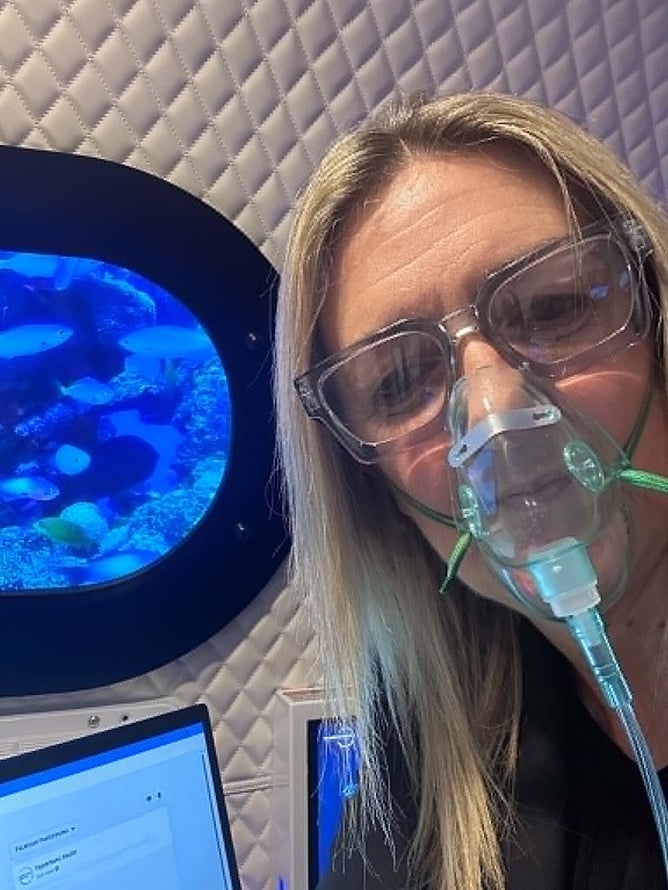
Why I Use Hyperbaric Oxygen Therapy
I spend an awful lot of time telling other people about Hyperbaric Oxygen Therapy.
Why athletes use it. Why people recovering from an injury or illness use it. Why people motivated for healthy ageing and longevity choose to incorporate it into their health routine.
But recently I realised something…
I very rarely tell people why I use it myself.
And perhaps I should.
I'm in my early 50s — and I don't want to simply accept ageing
I'm in my early 50s.
I stay physically active. I stay socially active. I run a business. I'm married, and we have a daughter who is currently on her OE.
I want to keep doing all of those things for many years to come.
And I don't subscribe to the idea that we should simply accept physical decline as an inevitable part of getting older.
Of course, ageing is inevitable.
But I don't believe that everything that happens to our bodies as we get older should automatically be dismissed as:
"It's just normal ageing. There's nothing you can do about it."
I believe there is a lot we can do.
We can exercise. We can eat well. We can prioritise sleep and recovery. We can maintain strong social connections. We can look after our cardiovascular and metabolic health.
And, for me, Hyperbaric Oxygen Therapy is another part of that picture.
Creating the right environment for the body
One of the things that has increasingly interested me about HBOT is that it isn't simply about oxygen.
It's about creating a temporary physiological environment that is very different from the environment our bodies normally experience.
When we enter a hyperbaric chamber, the pressure around us increases while we breathe oxygen.
That combination increases the amount of oxygen available to the body and, importantly, changes the way oxygen is transported and delivered throughout the body.
Oxygen is fundamental to cellular energy production and tissue repair.
Our cells need oxygen to produce energy. Our tissues need oxygen to support normal function and recovery.
And when tissues are injured, inflamed or under stress, the ability to optimise the environment in which those tissues are trying to recover becomes particularly interesting.
For me, that's where HBOT fits.
My own experience with injury.
I've personally had two meniscus tears. I chose not to have surgery and instead focused on supporting my body through recovery, including the use of HBOT.
Both injuries naturally healed without surgery.
That personal experience has had a significant influence on the way I think about recovery.
Rather than simply asking:
"What's wrong?"
I increasingly think about:
"What does the body need in order to function and recover as well as possible?"
That's a very different question.
It's not just about injury. My interest in HBOT has also evolved beyond injury recovery.
I'm interested in what happens to our bodies as we age.
I'm interested in inflammation, circulation, cellular function, recovery and the ability to maintain physical and cognitive performance for as long as possible.
I'm interested in the concept of health span — not simply how many years we live, but how many of those years we remain healthy, capable and independent.
Living longer is one thing.
Living well for longer is another.
That's the distinction that matters to me.
I want to age well
I don't want to spend my 60s, 70s and 80s simply accepting that I should expect to become increasingly inactive, sore, tired or limited.
I want to keep moving. I want to keep travelling. I want to keep working. I want to keep spending time with my family and friends. I want to remain curious, engaged and physically capable.
And I recognise that the decisions I make in my 50s are helping shape the person I will be in my 60s and beyond.
That doesn't mean I expect to stop ageing. It means I want to age as well as I possibly can.
What does HBOT have to do with that?
For me, HBOT is part of a bigger picture.
It isn't a magic bullet. It isn't a substitute for exercise. It isn't a substitute for a good diet. It isn't a substitute for sleep.
But I believe there is value in giving the body the best possible physiological environment in which to perform, recover and maintain itself.
HBOT is one way I choose to do that.
I use it because I believe in being proactive about my health rather than waiting until something goes wrong.
I use it because recovery matters to me. I use it because healthy ageing matters to me.
And, perhaps most importantly, I use it because I feel that it is worth investing in my future self.
I also measure how I feel.
I'm not interested in blindly doing something simply because someone tells me it's good for me. I want to understand why I'm doing it. I want to look at the science. And I want to pay attention to what happens in my own body.
My own inflammatory markers are very low, and I feel fit and healthy.
HBOT is part of my weekly routine.
I'm not using HBOT because I believe it can do everything. I'm using it because I believe it can contribute something valuable.
We all have choices
There is a growing conversation around healthy ageing. And I think it's an important one.
We can't control everything about the ageing process. But we can influence many of the factors that contribute to how we feel and function as we get older.
We can choose to move our bodies. We can choose what we put into them. We can choose to prioritise recovery. We can choose to maintain relationships and social connection. We can choose to monitor our health.
And we can explore evidence-based therapies that support our health and wellbeing.
For me, HBOT is one of those choices.
I'm not trying to avoid getting older.
I'm trying to get older well.
And that's why I use Hyperbaric Oxygen Therapy.
I choose to age well.
I use HBOT.
- Samantha Winters