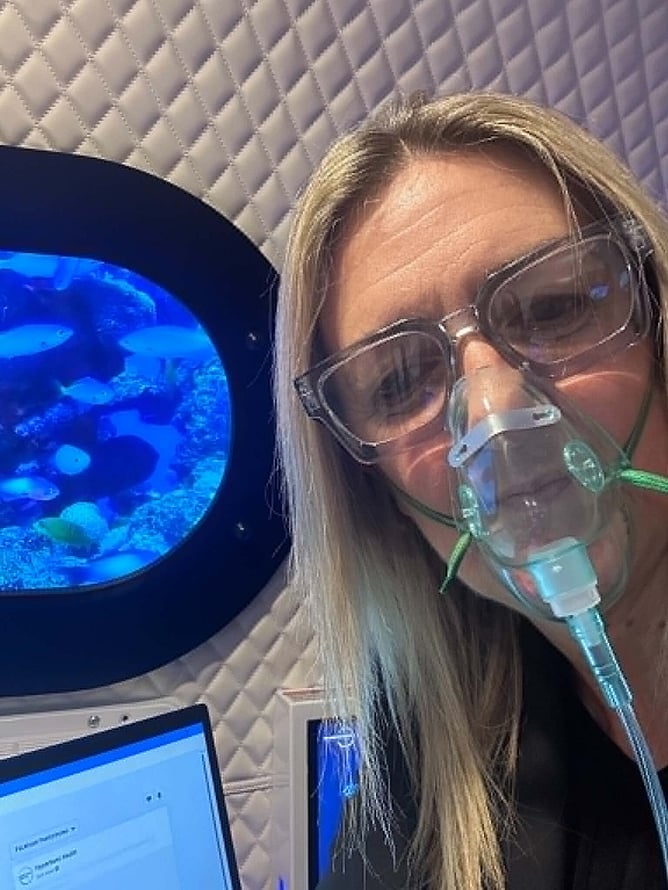
Breathe Easy: Why Calm, Natural Breathing Matters During Hyperbaric Oxygen Therapy
Oxygen gets much of the attention during Hyperbaric Oxygen Therapy (HBOT), but there is another gas that deserves equal consideration: carbon dioxide (CO2)
The relationship between oxygen (O2) and carbon dioxide (CO2) is one of the most important and often overlooked aspects of respiratory physiology.
During HBOT, the objective is to increase oxygen availability to the body's tissues. However, how we breathe during a session matters. Calm, relaxed and natural breathing helps maintain the delicate physiological balance between oxygen and carbon dioxide, supporting the body's normal respiratory and circulatory functions.
The message is simple: more breathing is not necessarily better breathing.
Understanding the relationship between oxygen and carbon dioxide
We tend to think of breathing as simply taking oxygen in and carbon dioxide out. But the physiology is considerably more sophisticated.
Oxygen is essential for mitochondrial energy production, cellular metabolism and tissue repair. Carbon dioxide, meanwhile, is not merely a waste product that needs to be eliminated. It is an important physiological regulator involved in:
- Maintaining blood pH and acid-base balance.
- Regulating blood vessel diameter and cerebral blood flow.
- Influencing oxygen delivery from haemoglobin to tissues.
- Supporting normal respiratory drive.
- Helping maintain the body's internal physiological equilibrium.
CO2 is therefore an active participant in oxygen utilisation and delivery, not simply something the body needs to get rid of.
The Bohr Effect: Helping oxygen get where it is needed
One of the most interesting aspects of the oxygen-carbon dioxide relationship is known as the Bohr Effect.
The Bohr Effect describes how increasing carbon dioxide and acidity (a reduction in pH) within metabolically active tissues reduced haemoglobin's affinity for oxygen.
In simple terms, haemoglobin can release oxygen more readily where it is needed most.
Think about exercising muscle tissue. As cells become more metabolically active, they produce more CO2. This helps signal haemoglobin to release oxygen into the surrounding tissues.
This is an elegant biological mechanism: tissues with greater metabolic demand create conditions that encourage greater oxygen unloading.
The relationship is important because oxygen delivery is not simply about how much oxygen enters the body. It is also about effectively oxygen is transported and released where it is required.
Why overbreathing can be counterproductive
When we breath too quickly or too deeply, particularly when there is no increased metabolic demand, we can inadvertently remove too much CO2 from the bloodstream.
This is called hyperventilation, and it can lead to a state know as hypocapnia (low arterial CO2).
The physiological consequences include:
- Reduced cerebral blood flow due to constriction of cerebral blood vessels.
- Changes in blood pH, making it more alkaline.
- A shift in the oxygen-haemoglobin dissociation curve towards tighter oxygen binding, potentially making oxygen unloading less favourable.
Research has demonstrated just how sensitive cerebral circulation is to CO2. Even relatively small changes in arterial CO2 can influence blood flow to the brain.
This is particularly interesting in the context of HBOT, where the objective is to increase oxygen availability throughout the body, including tissues with increased metabolic demands.
It is worth remembering that HBOT also increased the amount of oxygen physically dissolved in plasma, through the effects of increased ambient pressure. This is an important mechanism that operates alongside haemoglobin-bound oxygen transport.
Why calm breathing matters during HBOT
During a hyperbaric session, there is no need to consciously breathe harder, faster or deeper to get more oxygen. In fact, the opposite approach is generally preferable.
Encouraging clients to breath naturally and calmly helps avoid unnecessary overventilation and the associated reduction in CO2.
A relaxed breathing pattern also helps create a comfortable treatment experience, allowing the client to settle into the session rather that feeling that they need to actively do something to make treatment work.
At Hyperbaric Health, we encourage clients to:
- Beathe naturally and comfortably.
- Avoid deliberately taking repeated deep breaths.
- Avoid unnecessary breath-holding.
- Relax their shoulders, jaw, and facial muscles.
- Allow their breathing to find its own comfortable rhythm.
There is no need to deliberately retain CO2, or practice special breathing techniques during treatment. The aim is normal physiological breathing, not manipulating blood gas levels.
The bigger picture: Oxygen and CO2 work together
It is tempting to think of oxygen as the good gas and carbon dioxide as the waste gas. But the reality is far more interesting.
O2 and CO2 have a reciprocal physiological relationship. One supports cellular metabolism, while the other plays an important role in regulating blood flow, pH and oxygen uploading. The body is constantly adjusting this relationship to maintain homeostasis.
This is why the quality of breathing matters. We don't necessarily improve oxygen delivery by increasing ventilation. Allowing the respiratory system to do what it naturally does is the most appropriate approach.
The takeaway
HBOT is about creating an environment in which oxygen availability is significantly increased through elevated atmospheric pressure.
But the body is not simply an oxygen container. It is a highly sophisticated biological system in which oxygen, carbon dioxide, circulation and cellular metabolism are interconnected.
More oxygen is not the whole story. How the body transports, distributes and utilises that oxygen matters to.
So, when you're next in the hyperbaric chamber, take a moment to relax. Breathe gently, breath naturally. Let the pressure do its job, and let your physiology do what it has evolved to do.
Sometimes the best thing you can do is simply breathe.
- Samantha Winters